-
×
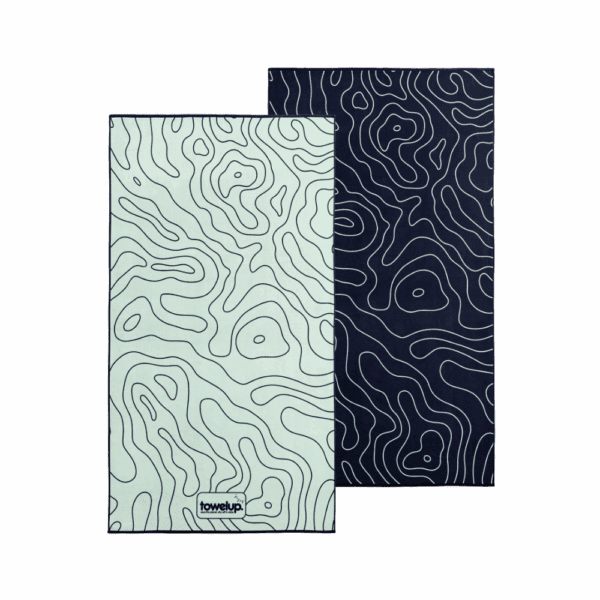 Midnight Topo
1 × $39.99
Midnight Topo
1 × $39.99
Subtotal: $39.99

There’s no shortage of beach towels to choose from, and most of them look pretty similar in a product photo. The differences only show up once you’re actually using one, which isn’t much help when you’re trying to buy the right one in the first place.
We’ve made beach towels for a while now, and we’ve also used a lot of the wrong ones before we started. Here’s what actually separates a good beach towel from a mediocre one.
It’s easy to get drawn in by a nice print, but the material is doing all the actual work. Cotton is soft and familiar, but it’s slow to dry, heavy when wet, and holds onto sand. Standard microfibre dries fast but can feel thin or plasticky against skin if it’s cheaply made. Recycled microfibre, done properly, gets you the drying speed without the plastic-y feel, plus the added benefit of not being made from virgin materials.
Grams per square metre, or gsm, is one of the most useful numbers on a product page and one of the least talked about. Anything under 300gsm tends to feel thin and less absorbent. Somewhere around 350 to 400gsm hits a good balance of absorbency and weight without becoming a towel that takes forever to dry. Above that, you start trading drying speed for thickness, which isn’t necessarily better, just different.
A towel that’s fine for a quick swim might feel too small for a full day out. If you’re the type who brings a book, a bag, sunscreen and snacks, you want a towel with enough real estate for all of it to sit with you, not scattered around you on the sand. We’ve written a full beach towel size guide if you want to go deeper on this one.
Most brands will say their towel is sand-free. Not all of them explain why, which is usually a sign the claim is more marketing than material science. A genuinely tight microfibre weave will resist sand. A loosely woven one, even if it’s technically microfibre, often won’t. If a brand can explain their weave and gsm without just repeating the word “sand-free,” that’s usually a good sign.
“Eco-friendly” gets used loosely across a lot of product categories, beach towels included. Worth looking for:
If a brand’s sustainability page reads like a single paragraph with no specifics, that’s usually the extent of the effort that went into it.
The cheapest option on the shelf is rarely cheap in the long run. A $15 towel that pills after three washes, holds onto sand, and takes two hours to dry ends up costing more in frustration than a well-made towel at a fair price. It doesn’t mean the most expensive option is automatically the best either. It means it’s worth asking what’s actually different between the $15 towel and the $65 one, beyond the print.
If someone asked us what to look for, ignoring the fact that we make towels ourselves, we’d say this: check the gsm, check if it’s genuinely recycled material with some kind of certification behind it, and make sure the size actually suits how you use a beach towel, not just how it looks folded on a shelf.